

The Science of Affection
5 days ago
One of the coolest things about being an online reviewer is that every so often, the creator of the piece you're saying nice things about will get ahold of your review. If you're really lucky, they'll use what you said as a reviewer tag for their book. It's kind of getting published by proxy... except nobody pays you, and you don't really get any accolades other than from your friends that look at you like you're the most pathetic creature on the planet. Not as good as say, getting your first novel published, but pretty damn cool nonetheless.
Ian Carney, the genius writer responsible for many of my absolute favorite comics reads contacted me by e-mail, asking if he could use a blurb from the Sugar Kat review for their upcoming graphic novel collection, Your Ticket To Happiness . This was fairly mindblowing for two reasons. First was how the hell he even got ahold of the review considering SAVANT has been dead for just over a year (though the archive is still up.) The other brain scrambler was why on earth was he asking me to use my work as a blurb. Nobody had ever been that thoughtful towards me before. Maybe they're just more polite in England.
Anyone who wants to get ahold of a copy of Where's It At Sugar Kat? The Thin of the Land should order it online from Amazon.com (I actually much prefer Khepri, but they're out of stock. I'll have a post about Khepri later to tell you why.)
and if you're interested in where Sugar Kat comes from, check out Your Ticket To Happiness when it hits the shops. It's a collection of Ian and Woodrow's anthology comic Sugar Buzz, and it's sure to be spectacular.

A Review of Where's It At Sugar Kat? The Thin of the Land
by Ian Carney and Woodrow Phoenix
Slave Labor Graphics
$12.95
The cashier at the video store gave me a funny look. She stared at me, sizing me up. She cocked an eyebrow, looked down at the DVD I'd just slapped on the counter and asked, "Underdog?"
I nodded, "It's a cartoon series."
She stared at me, blinking slowly like cows often do when events happening around them are overriding their thought processes. "Uh huh," she responded, sizing me up again skeptically.
I smiled tightly at her, trying not to think about the Guernseys standing out in the field next to our apartment complex staring with rapt attention at the nearby roadway. "Yes." I said quietly. "It was one of my favorites when I was a kid."
A light of understanding crossed her face. "Oh, I get it. It's a nostalgia thing."
"Right." I replied. I gathered my receipt and bag, and quickly left.
I rail about the current nostalgia boom all the time. I hate that the toy market is currently flooded with shitty mass produced toys, rendered poorly from long lost images of my favorite cartoon characters. It drives me absolutely batshit that comics companies are throwing together poorly written, badly drawn, half-assed attempts to separate me from my money, in the lame hope that I'll fork it over for this drivel. I hate all of this, but the simple fact is that I understand it.
I understand why shit like G.I. Joe, Thundercats, Battle of the Planets, and Masters of the Universe sells and sells well. We all miss certain pieces of our youth and sometimes the driving need to recapture a part of it, any of it, is overpowering. I even understand the retailers' reactions to all this. The comics market has been soft for several years and comics companies will try anything to get people reading again. If it means selling off their souls and every last shred of integrity to the gigantic nostalgia demon, so be it. It's fucked up that it should be this way, and it's depressing. But, just when you think all hope is lost and that everybody grabbing for a slice of the big nostalgia pie is a banking on P.T. Barnum's famous mantra, "A fool and his money are soon parted" being accurate, somebody gets it right.
Flash forward to later in the day. The cashier at the comic store gave me a funny look. "But you love Micronauts. You're always on about them, about how cool they were and how much you miss buying them off the shelf. Why wouldn't you want the new comic book too?"
I stared back at him, blinking slowly and doing a passable impression of the video store clerk earlier that morning. "Look," I said resolutely. "I just can't... okay. I can't support this comic. If it were any good at all I would but... Look, I read your preview copy and it was just... just bad."
He shrugged, "Whatever man. I don't know what's up your ass, but this baby is gonna sell like hotcakes."
My hands were balled into fists, and I was shaking, ready to come over the counter at him. But my girlfriend, who'd been pawing through the Indy graphic novels in the hope of finding something she'd missed by Ted Naifeh, chimed in, "What about this one? This looks like Saturday morning cartoons."
So I bought Where's it at Sugar Kat? and that evening I forgot all about my day spent dealing with retail jackasses. I was transported away, back to a time where the entire world was laid out in front of me for a six-hour stretch every Saturday morning.
Ian Carney and Woodrow Phoenix get it. With Where's it at Sugar Kat? they have distilled the physical essence of Saturday morning cartoons and bottled it up in a 100 page graphic novel. This is nostalgia the way it should be, homage, not hype. They have given us a complete, multi-layered cartoon in the form of a black and white graphic novel. Where's it at Sugar Kat? hearkens back to the days of our youth when between seven in the morning and one in the afternoon, once every week, we were all transported to other lands. It reminds of simpler days when all we needed was a television, a good sugar buzz and some milk. But like any good cartoon we enjoyed when we were kids, the story succeeds on many levels.
On the surface, Carney's plot is classically simple. He introduces us to the Kat sisters. Sugar is a multinational super model, adored by all. Rebecca is her largely ignored twin sister. Sugar is a vapid self involved Barbie Doll who, of course, gets her every wish. Rebecca is a super intelligent private eye who takes on cases that prove too weird for normal investigators. Together they take on an image obsessed town that has been overrun by one of the more disgusting bands of super villains to ever ooze all over the pages of a comic book.
When you read a little deeper though, the story takes on a few new levels of meaning. Sugar is spoiled and not self aware, but very bright in her own way. We are treated to several scenes of Sugar dealing with her agent and proving to us why she is her own cottage industry. Rebecca has a huge chip on her shoulder about Sugar, which prevents her from making friends. It's an intentional over exaggeration of sibling rivalry that makes its point quite clearly. All of this comes to light when Rebecca and Sugar are hired to solve a brewing mystery by Rebecca's pen pal Mimi. The residents of Mimi's hometown are obsessively weight conscious thanks in no small part to Sugar's constant over exposure in the media. This leads the townspeople to strike a bargain with devils for which they pay a terrible price.
Of course all of this gets wrapped up with an ending reminiscent of, "And I would have gotten away with it too if it weren't for you meddling kids."
Woodrow Phoenix's artwork compliments the story perfectly. On the surface it's simple, clear and cartoony. Once you dig a little deeper, though, his fine line rendered black and white drawings are chock full of subtleties. The fact that Sugar is obviously of African-American decent doesn't hit home until you really look at the pictures. The fact that Rebecca is actually quite beautiful when she lets her hair down doesn't really register at first glance. Phoenix puts in all sorts of visual cues, like the little twinkles that surround Sugar whenever she's on camera, or the fact that Rebecca is always lighted from the floor up when she's being intense, and it works.
Ian Carney and Woodrow Phoenix have written a love letter to the late, lamented cultural playground of Saturday morning cartoons. While it is a simple story at its core, and perhaps even a silly one, it is told extremely well and doesn't ever try to be more than it is. Many of the current "nostalgia" titles could take a lesson from the care and craft Carney and Phoenix have put into telling this story, because the result makes something far better than simply reliving childhood memories. Sugar Kat is suitable for children and adults. The action is intense and occasionally kind of gross, but this is the sort of tolerable terror that made cartoons like Scooby Doo or Bullwinkle and Rocky really special.
This is yet another of those SAVANT essays, except that this one never got published. The magazine folded before I got the chance to run it. Too bad, because I'm sure it would have ruffled all kinds of feathers.
SAVANT had a Delphi forum that was quite the happenin' place to hang out. A lot of industry creators would check in there from time to time, and a lot of the online journalists too.
One of the greatest of the aforementioned online crew is Johanna Draper Carlson. The inventor of the Squiddy Awards and curator of one of the best online comics review sites out there Comics Worth Reading , Johanna frequented the Delphi forum (even got conned into writing an essay for SAVANT once.)
At some point, somebody said something that was gender biased in the extreme, and she whopped the boy's ass for it right in front of God and everybody. At first I thought, "Geez that's a little hyperreactive," but the more I chewed on what was said, and the more I mulled over her reaction to it, the more I thought she had a point. This would have been my response to the whole sordid affair, and kind of my homage to Johanna.
So, we go at it again and again, round and round, 'till death do us part.
"I can't believe you put so much time and money into those things."
"Well, if you'd just try reading one, you'd probably like it."
"I doubt it."
"Well, at least try one. Here, you like Buffy the Vampire Slayer on the TV, try the comic."
"Sure honey, I'll get right on that."
Grow the fuck up. Your girlfriend isn't interested in your comics because she doesn't think there's anything there for her. As long as you keep catering to that thought and reinforcing it by dragging her to your shithole comic book store every week, she'll never come around.
It's long past time to unfuck your heads about women readers, boys. They don't want to be treated like women readers. They just want to be treated like readers. Unfortunately, that's the problem. Generally, comic book fans (the boys at any rate) are needlessly tolerant of a lot of bad behavior that most rational people, men and women alike, would find outright repulsive. The society of people who read and create comics is insular, and strongly dominated by men, and as men, we have a tendency not to think about how we act or how we write or speak to our female compatriots. We have a tendency to objectify the female form, and to marginalize the opinions they have. We often trivialize the creativity and talent they can bring to our hobby.
None of this is anything new to you all. Of all the societies I can think of that are based in and around enjoyment of an art form, maybe pornography is more condescending and gender biased towards its female fans and creators. Maybe. When was the last time a retailer handed any of you men a comic and said, "Oh, you're a boy so you should really like this." I've witnessed this scene repeated countless times with countless women in countless comics stores. When was the last time an entire store looked at you like you were some kind of alien life form? Unless you are a burn victim, not bloody likely.
That's assuming they even make it in the door. Take a good, hard look at your comics shop. Is it clean and well lighted or is it a dungeon that reeks of stale Thai food and body sweat? How many posters advertising scantily clad, impossibly shaped women, permanently stuck in submissive soft-core porno poses do you see? How many titles on the rack mirror this? How about the employees? Do they act like retail professionals or college frat-boys on the prowl? How often does Cat-Piss Man show up? (Remember, he grows like fungus. I think the term is budding.) When my girlfriend goes into any comics store with me, she's never far from my arm. She doesn't feel safe there, and the store I frequent is fairly clean, smells okay, and the owner is a decent guy who makes a fair attempt to remain a professional retailer. The patrons, and the store's general décor, however, are other matters entirely. (For those of you not familiar with the abstract of Cat-piss man, check out Paul T. Riddell's field guide, The Wrath of Cat-piss Man.) Superheroes abound at both my comics stores, and where there are superheroes, there are adolescent male power fantasies. Soft-core pornography for 15 year-old boys is the order of the day.
Of course, there are exceptions to every rule. There are certain females who have a thick enough skin, and a strong enough stomach to brave the average comics shop. After all, tolerance is a common enough trait in any human. If you're a woman, and you have the misfortune to pick up your average superhero book, there isn't much there for you. Primarily, these are stories that appeal to boys in their middle teen years. Few creators working within the superhero genre (Yes, I'm picking on superhero books here, simply because they are far and above the most prevalent in most comics shops.) ever seem to even think that they might have a female audience, and it shows.
For an even more insidious bon mot, go check out Gail Simone's stunning online essay, Women in Refrigerators. It's a frighteningly large necrology of female comics characters that have been gratuitously debased, humiliated, de-powered or killed within the pages of our favorite hobby. It's stomach churning to see it laid out all at once for you. The real boot to the head though, is the "creators respond" listing. She put a lot of industry creators on the defensive with this essay. More importantly, though, she made them think about how female comics characters are commonly treated within the superhero genre.
My point here is that the comics creators should know better. There are an infinite number of better ways to build dramatic tension than fucking up the hero's girlfriend. I'm not saying it should never be done (I still think the Claremont/Byrne Dark Phoenix Saga worked extremely well.) but I am saying that this fictional trope is overdone in the extreme, especially in comics. Any potential female comics reader is walking into hostile territory from the start. It's no wonder that a lot of them leave and never come back.
So what can we do about all this? Should we even try to do anything about this?
I can't argue with the fact that things are getting better. Comics have more women creators than ever before, and they're starting to reshape the landscape. Brilliant writers like Devin Grayson, Gail Simone, Rachel Pollack, and Caitlin R. Kiernan are proving on a regular basis that gender has nothing to do with how well you can tell a story. Artists like Lea Hernandez, Sarah Dyerr, Anne Timmons, and Carla Speed McNeil are starting to build castles from the foundations set up by veteran creators like Wendy Pini, Trina Robbins, Roberta Gregory, and Colleen Doran. The recent collapse of Chaos Comics is a good sign that the industry is starting to focus more on solid entertaining stories and less on gratuitous T&A.
Yes, we are getting better, but we're doing this too slowly, and it's not enough. A world where genius writers like Devin Grayson and Gail Simone still get asked, "So, what's it like to be a woman writing comic books," is not a world we should be living in. If they were less polite, their stock answer to this question would be, "It's fucking horrible! We're forced to work for low wages and minuscule recognition. Dirtbag editors who think we can't write because we're 'girls' give us shitty assignments. And to top it all off, we have to come to these jacked up conventions and endure hours of endless, drooling, rambling, by mindless fuckheads who don't bathe." There's something special about blending words and pictures that makes people tolerate a lot of things that they probably shouldn't.
So, how do we as a comic book society solve this problem? Simple, start thinking before you write, speak or draw.
Journalists, remember that part of your audience is female. They don't want to be treated differently from the males, but they do want you to be mindful that they're reading.
Creators, you should know better. You're usually a little older than your fan base, just remember to act like it. If you need help take a look at the body of work put out by Brian Wood, Neil Gaiman, and Alan Moore. Strong female characters all around. Artists who want to follow in the footsteps of Jim Balent or Brian Pullido should be shot on sight.
Fans and comics store employees... short of mass sterilization, there's not much hope.
Yup, this story is absolutely true. I changed the names because I'm quite certain the surviving parties wouldn't want me plastering their names all over the internet.
I originally wrote this piece for an online magazine called SAVANT. It had a weekly section called "Essential", which was basically a long essay about "pick your graphic novel."
Over the few years it was active, SAVANT degenerated drasticly. But I always tried to write by the rules that were set down by SAVANT's heart and soul, the excellent Matt Fraction. If you want to check out his online journal, it's at Matt Fraction's Website. Within the rules that Matt wrote out for SAVANT's review style, there was an admonishment that they didn't want reviews of things like Watchmen, The Dark Knight, etc. and I personally felt that The Crow definitely fell into that "etc." The thing's been reviewed to death.
In breaking those rules, I turned out one of my favorite pieces in the Dan Traeger catalog (such as it is.) Hope you like it.

A Review of The Crow
by James O'Barr
Pocket Books
$16.95
There are places in our hearts we don't often visit, dark corners that wall us in during the early morning hours. You've been there, just as I have. You snap awake and the room that should be familiar is strange and you're unsure of yourself, shrouded in twilight memory, slipping into blackness. The void calls to all of us.
I bought The Crow graphic novel again. This will be the seventh copy I've either worn out or given to a friend. Maybe I'll hold onto this one awhile. It has been too long out of print. It's back now, like an old flame you haven't seen in a long time. Someone who shares secret things with you, things that you keep locked away in the dark corners of your heart, tucked deep within the places you don't like to go. Everybody knows tragedy of some form. The void calls to all of us.
I can't tell you much of anything about James O'Barr's masterpiece that you don't already know. After the movie came out, everybody read it. Everybody reviewed it, dissected it, and reinterpreted it. The Crow captured the hearts and minds of everyone it touched, leading us up from the dark places in our souls by giving us revenge and more importantly release.
The movie, Brandon's tragic death, and the endless sequels have all become grist for the mill of public consciousness, the comics likewise. There is no point in giving you yet another review of a story you know. Tonight, I offer instead a story told in snapshots. I offer a bit of tragedy locked away within a dark corner of my own heart, which, in the final analysis, illustrates perfectly why we are all so touched by The Crow.
It's early morning, about three by my clock radio. Green neon numbers stare impassively at me, admonishing me. I should be asleep. The room is cold and abuzz with the quiet hum of our air conditioner, the purring of our three cats, and the soft snoring of my girlfriend and our dog. Tonight I draw no comfort from these familiar sensations. I'm awake, dancing with the ghosts of my past. Eric Draven's cold raging eyes stare up at me from my nightstand, and I pick up my new graphic novel. Twice in my life, this story has helped me when I needed a hand up from the depths.
Tonight I'm thinking about Katie. It's not something I do much any more. She's been gone for a long time and her ghost has faded from my life. But tonight, a flickering of memory brings her back to me, and I hear the sound of wings.
We first meet in a comic shop.
I'm living in Santa Cruz, two months out of the Air Force, still recovering from military programming. I'm staying with my friends, Shane and Debbie. Shane is teaching me how to surf, and I'm enjoying not having a job. Katie and I both frequent Atlantis Fantasyworld. We run into each other on new comics day. We say hello. We always make it a point to check out what the other is buying. We often get into good-natured arguments. She's a freak about superhero comics. I think the genre died in the early eighties. She's warm, funny, and she never looks up when she's listening to you, which drives me crazy.
It's early on a Saturday, and I'm hanging out, chatting up the guys at the counter. The topic of the day is some inane bullshit about David Sim and Cerebus. I'm in mid rant and I'm stopped cold when a 5'6", gorgeous, redheaded vampire bounds across the room and bites me full on the neck. I short circuit. It's one of the few moments in my life where I have absolutely nothing to say. Later, we're out having coffee, and I ask her why. She laughs and remarks that it was the only way she could think of to shut me up. From that point on, we're inseparable.
And it's six months later. We're living together now. We're a couple, and it seems to agree with both of us. Shane and Debbie adore her and for some bizarre reason Katie's parents like me. We're not perfect. We fight occasionally, and one time I inadvertently make her cry. Most of the time though, we're good together. We love each other, and we're happy.
And it's a week into our seventh month together. Katie leaves to pick up her sister from her parents house in San Jose. She makes it there okay, and she calls at about noon. She tells me she's going to stay for dinner, and she asks if I could join them. I tell her yes, I'll be there directly after work. I'll join them at the restaurant. Our conversation ends happily enough with my cracking wise about her mother's stubborn refusal to cook, even though she's a professional chef. I love you, and I'll see you soon.
Then the void opens up and swallows Katie whole. The next time I see her, she's small, pale and lifeless. She's smiling peacefully. It's a look that will haunt me until I die. Her parents and the police lay it all out for me later.
She had a headache that afternoon. There was no Tylenol in the house, and she was stubborn about not using anything else. There was a market close by, so she walked. On her way back, a young man who had made a bad judgment call, lost control of his vehicle. It careened through an intersection and into the crosswalk, just as Katie was stepping off the curb.
And it's a week later. Her funeral is rainy and cold.
And it's a week later. I've withdrawn completely into a dark place.
And it's three weeks later. I've long since been fired from my new job. I've been thrown out of every bar in Capitola. I'm still trapped within the void, drowning in a bottle of the same thing that killed my girlfriend.
And it's a week later. I'm still miserable, but I'm starting to think that maybe I should go get some help. I'm sitting on the beach at Capitola by the Sea, staring off into the bay. Shane is sitting beside me. I have no idea how long he's been there. I haven't seen him since the funeral. I've done my best to push everyone away and disappear down a bottle of Mescal. Shane knows me; he knows where I am all the time. He's been checking up on me, marking time and holding my place in the world open for me. He sits beside me for a while, long enough, I think, to be sure I've started to bring myself up from the dark place. Finally, he hands me a stack of comics and he says, "Here, these might help a little. This guy went through the same thing you just did, and he did a comic book about it. When you're done being alone, come home. We miss you and we want you back."
Sitting in the sand at the edge of Monterey Bay, I read The Crow for the first time. It hits me like ice water as I see every ounce of pain and rage that I feel at the world spread out on the pages before me. It forces me into a moment of clarity. Eventually I work through the pain. I continue on.
And it's seven years later. Time has dimmed the pain, as it always does, and I no longer wake up with Katie's name on my lips. The void doesn't call to me much anymore. I'm comfortable, a bit more settled. I'm half a world, and six years away from Santa Cruz.
And the phone is ringing. There's an unwelcome sense of foreboding as I pick up the receiver. It's Debbie. She's telling me that Shane is gone, swallowed up by the ocean that he loved so much. The void opens up before me. Once again I pick up The Crow and read it through.
I can't go to the funeral. I have responsibilities, work commitments I can't break. I ask Debbie what she needs, and she tells me she wants to go home. I make the arrangements and I send her a plane ticket to Seattle. As an afterthought, I grab up those four original issues of The Crow and send those along too. I write her a brief note that reads, "Here, these might help a little. Shane once gave me these at a time when I really needed them. When you're done being alone, go home to your family. They need you. We all need you. The world is a much better place with you in it."
And it's two years later. I'm awake, it's late and I'm staring off into the black void of my past. And it's okay because I'm not alone. For the first time in my life I finally realize I was never alone. I reach over and I stroke my girlfriend's hair just slightly. She murmurs and stirs a bit. The cats snuggle in closer, sucking in body heat against the chill of the room, and all is well.
The Crow graphic novel is back in print. The original four issues remain undiluted, expanded into graphic novel, but unchanged in form and substance. They are still an affirmation of life and what it means to have to be the one who goes on living. James O'Barr has given us a tether to help bring us out of the dark places. We will always have The Crow to show us that we are never alone when the void reaches out to us.
Being a short illumination on the difference between the horror and fantasy genres.
When Courtney first read this review, she was annoyed that I didn't take the time to explain the difference between fantasy and horror. Apparently the irony of the joke was lost on her, however... the more I thought about it, the more I thought maybe she had a bit of a point there. After all, the difference is often blurry at best.
So, let's take two movies as patent examples of my point, The Evil Dead 2 and Army of Darkness.
The Evil Dead 2 is your classic "horror" flick. The dead reawaken and start kicking everybody's ass, there are magic spellbooks form the pit of hell, the requisite girlfriend buys it early on. There's lots of suspense, lots of shocks, loads of creepy music, and not a mighty thewed barbarian to be had at all. Also no swordplay... very important for a fantasy film to have swordplay.
Army of Darkness, however, has tons of swordplay, a castle to protect, knights and heroes abound. Still no barbarians (and really no thews either, mighty or otherwise.) But it's definitely a fantasy film, to be put in the same category with The Princess Bride, Legend, or Jason and the Argonauts.
Okay, I admit it, the difference is a subtle one, but it is there.
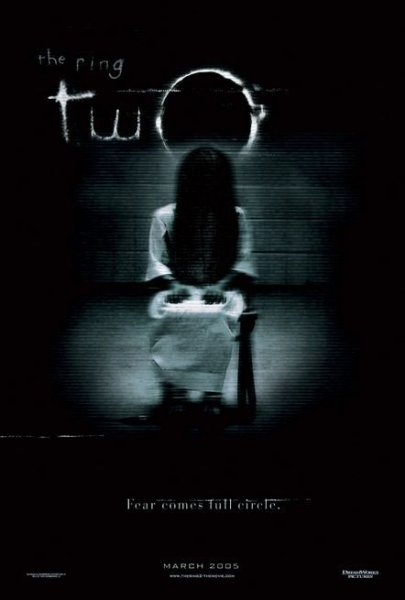 Being a review of the movie The Ring 2
I have decided just today that I am the reincarnation of Pollyanna Whittier. I have this recurring waking dream that one day someone in Hollywood will say, "You know, that was a good movie, but enough is enough. Let's do something completely original and not make another one." It's a small dream with absolutely no chance of ever coming to fruition, but it's sweet, and it's mine.
I also dream that one day Michael Bay will no longer be allowed to make movies, but I'll save that for my review of The Island.
Within the entire litany of every horror movie ever made, I am hard pressed to find one that ever spawned a sequel that was even remotely decent. (You Scream fans already know the difference between a sequel and a Trilogy, so I'll spare you there, and all of you Army of Darkness fans can stop jumping up and down while I explain the difference between the fantasy and horror genres.) So, I shouldn't have been surprised that I hated The Ring 2, but I have a soft spot for horror movies, (and an even softer spot for a girl with a soft spot for horror movies), and the optimist in me is generally just too damned obnoxious to ignore.
For those of you keeping score, at the end of The Ring, our intrepid, hero-Mom, Rachel Keller (Naomi Watts' breakout role) makes a copy of the deadly tape to save the life of her son, Aidan (David Dorfman). The Ring 2 begins with Rachel and Aidan starting over in a small town, trying to put all that Samara nastiness behind them. Ah well, you can't blame a mom for trying.
The movie starts out well enough with a high school couple getting a hold of a copy of Samara's videotape. The requisite calamity ensues. Lots of creepy imagery, lots of, "oh no, Samara is back, and she's after the kid again. What is Rachel gonna do?" And then...
Rachel does pretty much exactly what she did in the first movie. So similar are the plots of The Ring and The Ring 2 that I almost want to have my lawyer ring up Hiroshi Takahashi and Hideo Nakata about that $15 I shelled out for the tickets to this thing.
The worst kick to the head with this movie comes late in the show. No, it's not the silly-assed scene with the deer, nor is it Nakata's drastic overuse of water imagery (a trend that doesn't look to be letting up anytime soon, judging by the previews for his next movie, Dark Water). Rachel, consummate investigator that she is, finds Samara's birth mother, Evelyn (played with creepy effectiveness by Sissy Spacek). When it's revealed that the reason Samara is possessing Rachel's son, is that she just wants a mommy, it never even crosses Rachel's mind to get these two together. Samara possesses Evelyn, Evelyn gets to spend the rest of her days with her lost child (sort of). Samara gets to work out her mother issues right at the source. Plot gets tied up nicely, leaving virtually no opening for The Ring 3. Everybody wins.
One final note about the actors. There wasn't a lot of chemistry between Naomi Watts and David Dorfman in the first movie, but Gore Verbinkski played off that estranged feeling, and used it to ramp up The Ring's pervasive feeling of impending doom. In the sequel, that absence of on-screen chemistry detracts immensely from the story. So much so, in fact, that I had an extremely difficult time reconciling all the gyrations Rachel goes through to save her boy's life, with the way they treat each other when they're not being stalked by the crazy, electronic, ghost lady.
The Ring 2 is just bad. It's full of internal logic inconsistencies, stupid, non-sensical imagery (the deer, the deeeer), and it commits the worst sin a horror movie can commit. It's flat out not scary.
Unless you are a completist, or just a masochist, it's not even worth renting on DVD. The Ring 2 is a listless, meandering mess that fails to entertain on any level. Go waste your money on something else.
Okay, so....
Before I caved and finally got my own Blogger account, these posts were always posted on (girlfriend) Courtney's blogger journal first, so I figured I'd add little snippets of behind the scenes stuff to keep anyone who reads both The Daily Cat Chase and this one interested. It was such a good idea that I think I'll keep doing it.
So, this is the deal. Courtney is the poster child for adult ADD, and as such, is a fidgety widget when it comes to watching movies in a real-life honest to Gawd movie theater. She has little to no appreciation for the overpowering smell of stale popcorn and body sweat, the sticky floors, the obnoxious children two rows behind us, the insanely tall bastard that invariably sits in front of her (she's 5'2"). Anyway, you get the picture. Me, I love the whole movie going experience. To me, seeing the characters up on that huge screen, hunkering down with a soda, snax, and that aforementioned stale-assed popcorn... it's a little slice of heaven.
I hate going to movies by myself. I want to dissect them afterward, and it just doesn't work if your lifemate and ultimate sounding board hasn't seen the flick at the same time. Yes, I do have buddies that would go with me, but I don't want to dissect with them. They have a tendency to think the same way I do, and that's no fun at all.
So, in her ultimate wisdom... not to mention a "you put the b in subtle" attempt to get me writing again, she hit on this deal. A pact with Mephistopholes if you will: I write one of these reviews, she sucks it up and takes me to the show. I cannot tell you how much I love this woman.
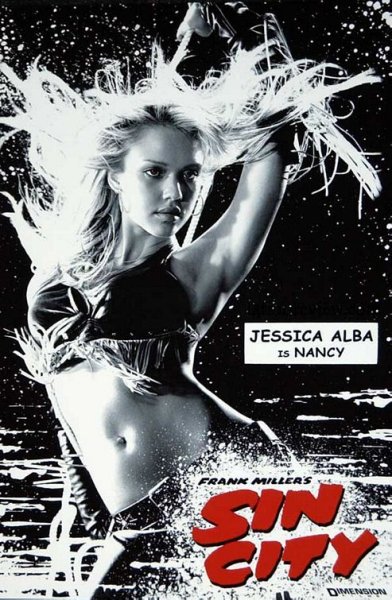 A Review of the film Sin City
Directed By: Robert Rodriguez, Frank Miller, and Quentin Tarantino
It's a gut wrenching heartbreak for a comic book fan. Hollywood has finally decided to make a movie of your favorite comic book series, and you're always of two minds. On one hand, it'll be neat to see those characters you've spent years of your life with put to flesh and blood and projected up on the big screen. Considering what they can do with CGI nowadays, you just know the special effects are gonna kick butt, too. On the other hand, there's so many years worth of back story, so many guest stars, so much time that you need to "really develop the characters," not to mention all the continuity issues, and who the heck are they gonna get to play The Wasp if Jessica Alba isn't available? Therefore, you're invariably disappointed -- it's never quite the same. They always bungle something, whether it's a minor thing, like giving Peter Parker organic web shooters, or something phenomenally stupid like giving Superman a big plastic 'S' that he can rip off his chest to capture the Kryptonian bad-guys.
Over the years, there has been a small handful of good comic book to film adaptations. Richard Donner's Superman, Tim Burton's Batman, Sam Raimi's Spiderman and Bryan Singer's X-Men. These are films that succeed in capturing the flavor of the source material, if not the actuality of it. Until now, the closest thing we've had to a direct comic book to movie translation was The Crow, and even Alex Proyas had to take some liberties with the story.
Robert Rodriguez knew exactly what he was doing when he came to Frank Miller with the idea for a movie based on his comics. Sin City is a series of loosely connected crime noir short stories influenced by every thing from Raymond Chandler to Andrew Vacchs. The comics are drawn in black and white master shots with occasional splashes of color, and framed with snapshot, hard-boiled dialogue that would put Elmore Leonard to shame. In short, they're a movie set to paper.
Sin City was Frank Miller's masterwork, and for years, he resisted the siren call of Hollywood. What finally hooked him was Rodriguez's pitch, "I don't want to adapt Sin City, I want to translate it." Thus was born something unique to the world of movies based on comic book source material, an exact, panel-by-panel translation.
And it works! Works well in fact. Rodriguez and Miller assembled an all-star cast, and judging by the gusto with which the actors have been hyping this movie on the talk show circuit, they obviously have a passion for the work. Bruce Willis, Clive Owen and Mickey Rourke are phenomenal as the anti-heroes that drive the three primary interconnecting plotlines. Even Rutger Hauer, who gave up acting and started phoning in his lines shortly after The Hitcher, gives us the best Marlon-Brando-in-Apocalypse-Now impression ever.
The visuals are stunning. Crisp digital black and white is cut by the occasional shock of color, making every frame of this movie a feast for the eyes. Using the same technology that made Sky Captain and the World of Tomorrow, a revelation in special effects mastery, Rodriquez has raised the bar by forcing the CGI to serve the story as subtle background.
Sin City is a movie that could never have been made inside the Hollywood studio system. It is pure in its vision, created by artists who love the material. As such, it's not hamstrung by the usual cast of talentless idiots that directors and writers are usually forced to deal with. Rodriguez understood the importance of having Frank Miller in a position of authority on this film. So much so, in fact, that he resigned from the Director's Guild of America when they protested the fact that a non-member was being credited as a co-director. With that move, Rodriguez now joins an elite club of non-guild directors that includes both George Lucas and his friend, Quentin Tarantino. If this movie is any indication of what Rodriguez can do when free of the Hollywood straightjacket, he has the potential to occupy a place of honor in the pantheon of great American motion picture directors. Orson Welles, John Huston, Alfred Hitchcock, meet the new guy, Robert Rodriguez. He did this film called Sin City. Go see it; I think you'll like it a lot.


